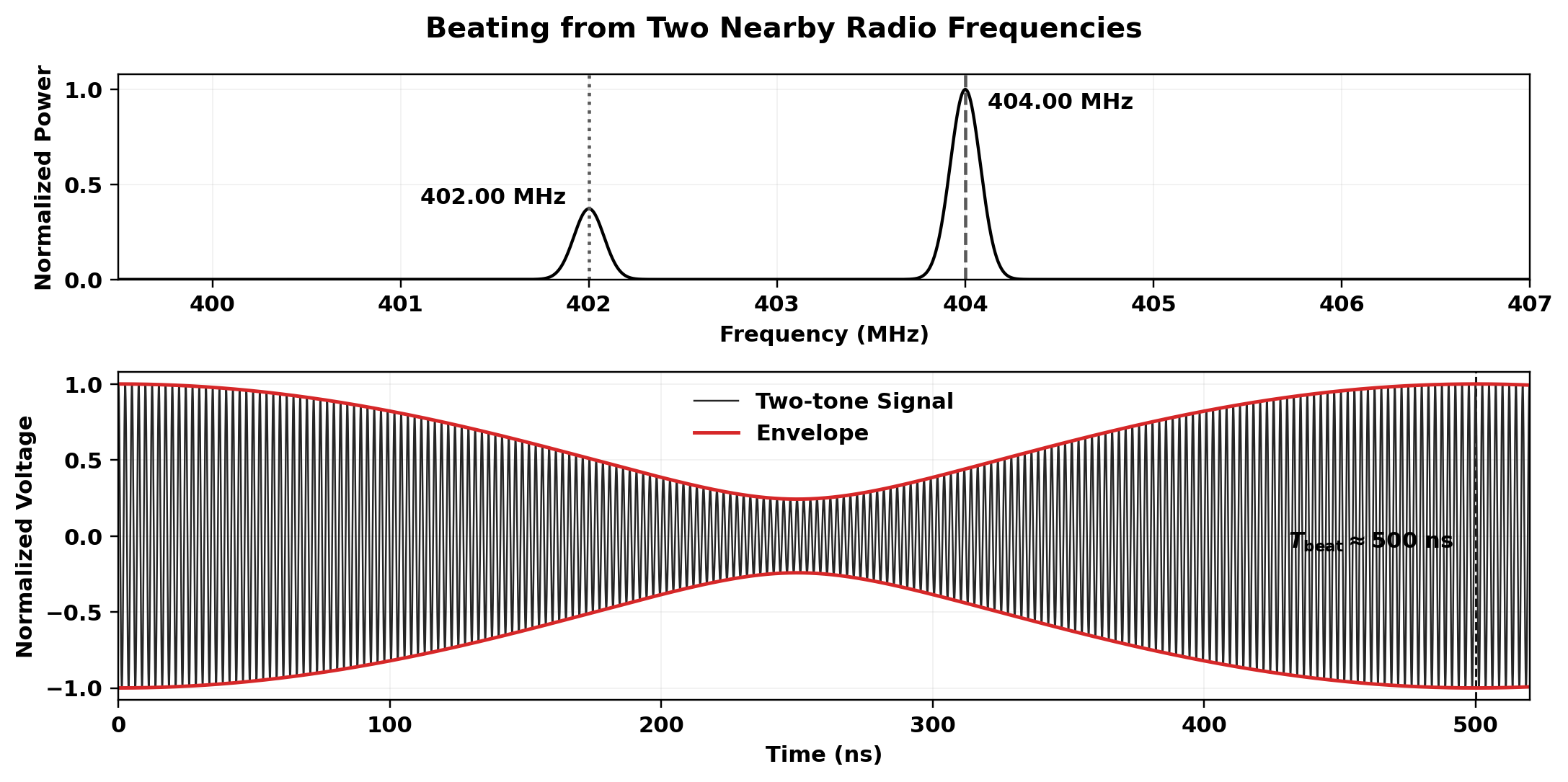
When two continuous radio-frequency signals lie close together in frequency, their sum can look very different in the time domain from either signal alone. Instead of a constant-amplitude oscillation, the waveform develops a slowly varying envelope: beating.
The difference frequency
For tones at frequencies f1 and f2, the envelope varies at the difference frequency
Δf = |f2 − f1|
and the characteristic beat period is
Tbeat = 1 / Δf.
For example, tones at 402 and 404 MHz are separated by 2 MHz, giving a beat period of 500 ns.
Spectrum versus waveform
The frequency-domain picture still contains two distinct narrowband components. The slower structure appears when the two oscillations are added together in the time domain.
If the amplitudes are equal, destructive interference can drive the envelope nearly to zero. If they are unequal, the modulation remains visible but the minima stay above zero.
Why it matters for radio detectors
A waveform with a slowly varying envelope does not necessarily imply a broadband transient. Two persistent narrowband transmitters can produce this structure simply by being recorded at the same time.
The relevant timescale is set by the separation between the carriers rather than by the carrier frequencies themselves. A separation of only a few megahertz naturally produces envelope structure on hundreds-of-nanoseconds timescales.
This provides a useful connection to the South Pole radiosonde environment, where balloon-borne transmitters can occupy nearby channels around 402–404 MHz. The beat phenomenon itself is completely general and applies whenever nearby coherent tones are superposed.