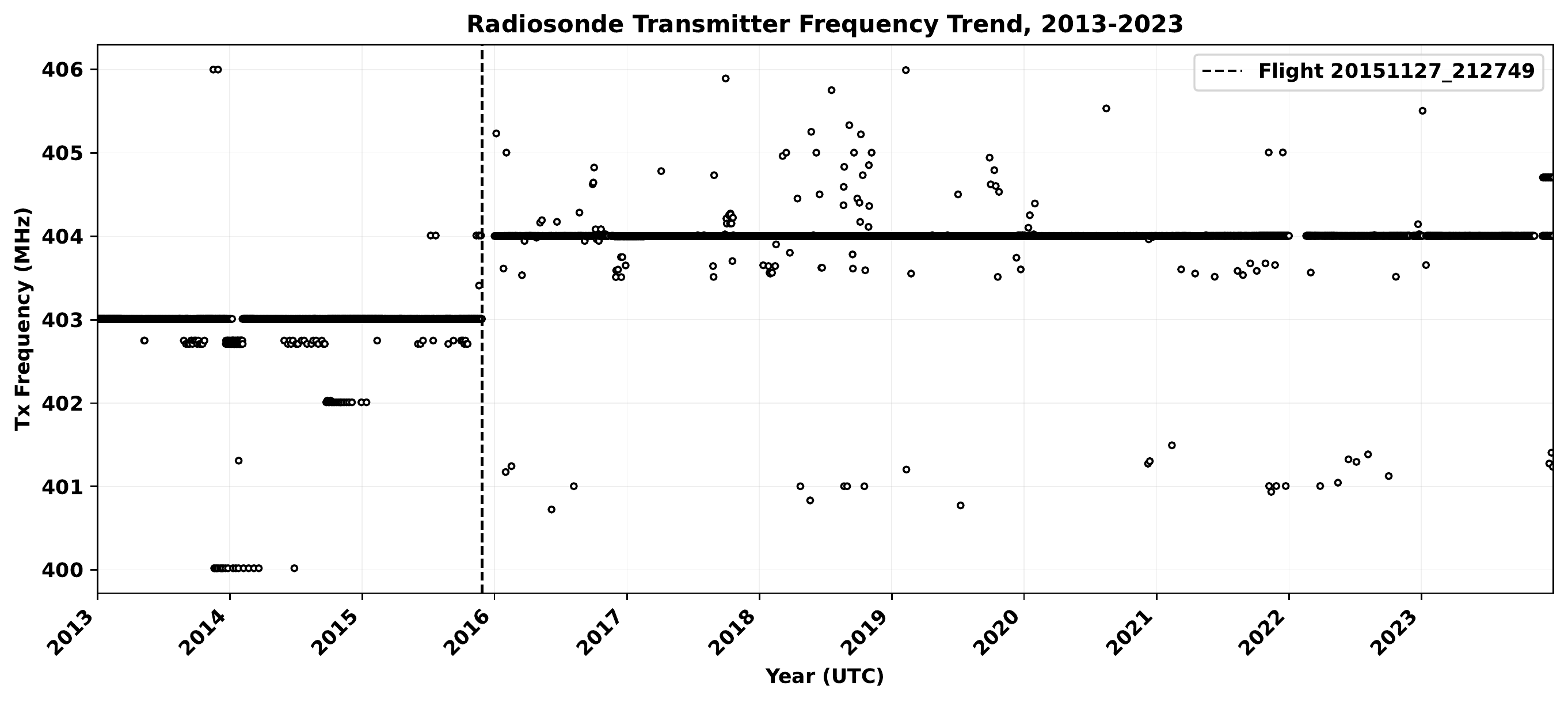
While studying the long-term radio-frequency environment at the South Pole, I found a sharp change in the routine radiosonde record: transmissions clustered near 403 MHz before late 2015 and near 404 MHz afterward.
The boundary falls on November 27, 2015, between the soundings SOUTHPOLE_20151127_092614 and NZSP_20151127_212749. The first sounding after the transition identifies the ground system as Vaisala MW41 version 2.3.0. The change was therefore part of a broader sounding-system transition rather than the appearance of a new radiosonde model.
Two balloon programs
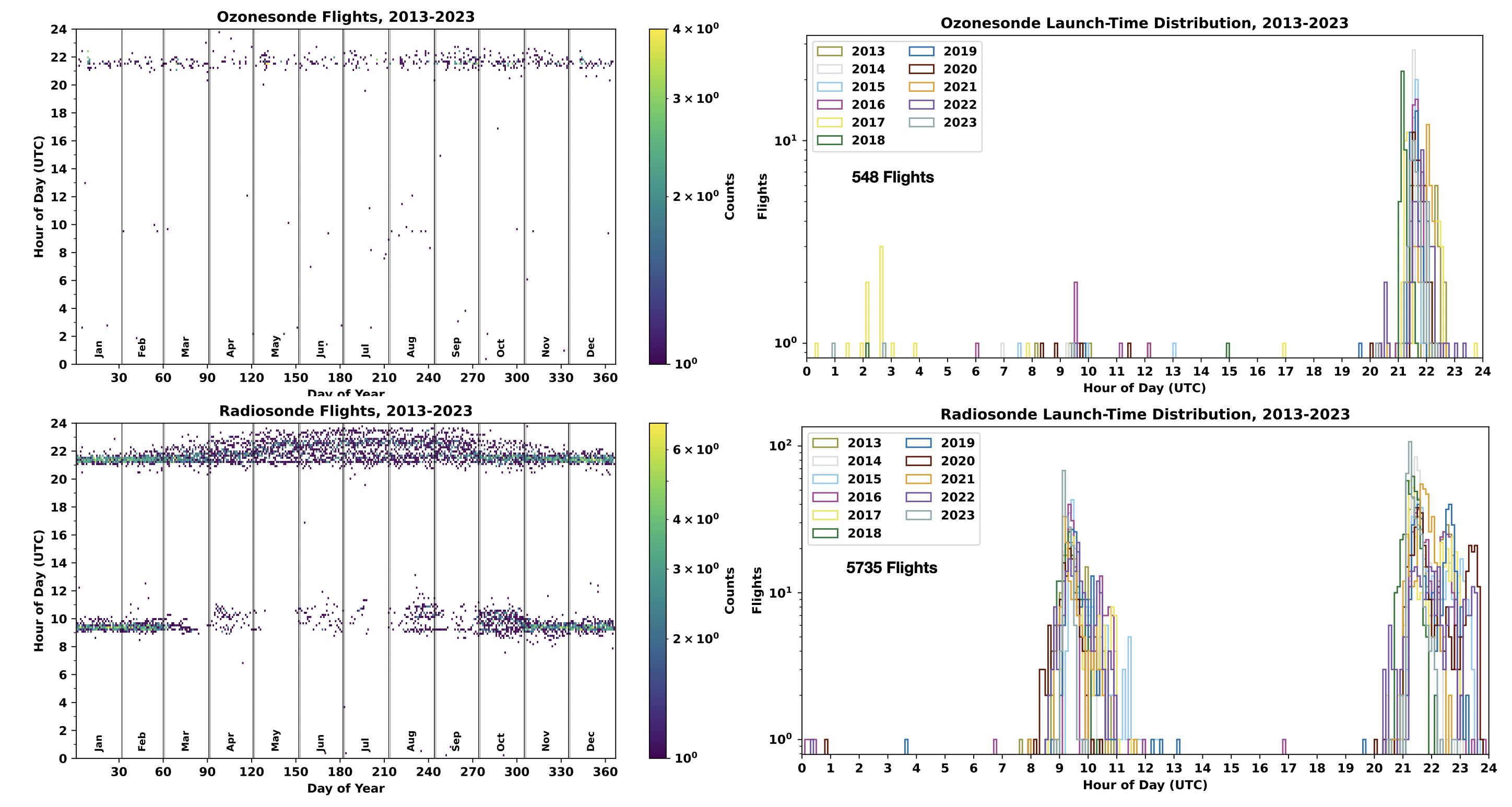
Routine radiosondes and ozonesondes both operate from the South Pole, but they serve different purposes and follow different launch patterns. Routine soundings provide atmospheric profiles, while ozonesonde flights add measurements of the vertical ozone distribution.
The distinction also matters in frequency space. The South Pole ozonesonde flights examined here used an iMet-1 radiosonde near 402 MHz. Some ozonesonde payloads could additionally carry a Vaisala RS-series radiosonde as a piggyback instrument for an independent meteorological profile.
What changed?
Ground systemDigiCORA/DC3DB → Vaisala MW41 2.3.0
Station identifierSOUTHPOLE → NZSP
Archive structureCSV/text exports → MWX/XML tables
Routine frequency403.010 MHz → 404.000 MHz
RadiosondeRS92 → RS92
The last point is important. The routine radiosonde did not change from an RS92 to an RS41 at this boundary. The pre-transition metadata identifies a Vaisala RS92-SGP, and the first MW41 sounding still identifies the radiosonde family as RS92.
What changed was its configured transmission channel. Both 403.010 and 404.000 MHz lie within the selectable operating range of the RS92-SGP transmitter.
The 402–404 MHz picture
Before the transition, the routine RS92 near 403 MHz was separated from the approximately 402 MHz ozonesonde iMet-1 channel by about 1 MHz. After the move to 404 MHz, that separation increased to roughly 2 MHz.
Greater separation would naturally reduce spectral overlap between nearby transmitters. It is tempting to interpret the reassignment in that context, but the available records do not document why 404 MHz was selected. What can be said confidently is that the frequency change occurred together with the MW41 commissioning.
Why it matters
For radio experiments, changes in station configuration can look like changes in the physical radio environment. A persistent narrowband source may move in frequency even though the transmitting hardware itself has not changed, while filenames, metadata, and archive formats can change at the same boundary.
Here, the 403-to-404 MHz transition is best understood as part of a sounding-system and configuration change, not the arrival of a new radiosonde model.
Data and documentation. Routine South Pole radiosonde records are from the Antarctic Meteorological Research and Data Center (AMRDC), in collaboration with the South Pole Meteorology Office. Ozonesonde launch information is from the NOAA Global Monitoring Laboratory South Pole Balloon-Borne Ozonesonde Profile Measurement Program. The transition was interpreted using archived sounding metadata together with Vaisala MW41 and RS92 documentation.
AMRDC South Pole meteorology → · NOAA South Pole ozonesonde archive →